Bass or Drums: Which One Is Carrying the Pulse?
Learn how bass or drums carry a song’s pulse, then use a focused listening exercise to separate their roles without losing the groove.
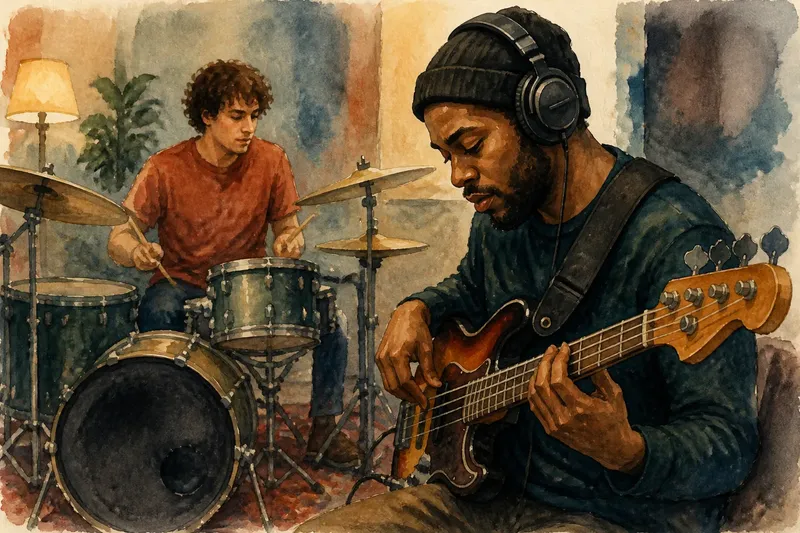
In a song with a steady kick drum and a bass line that keeps changing, the beat may seem obvious until the bass drops out—and the whole track suddenly feels less grounded. Bass or drums can carry the pulse in different ways: drums make time easy to spot, while bass gives that time weight, direction, and a sense of motion between beats.
To hear the difference, listen for what each part contributes rather than asking which instrument is louder. The pulse is the recurring sense of time you can tap or nod along with. It is not always identical to the drum pattern, and it does not have to sit in one instrument throughout a song.
Drums mark time while bass gives it direction
A drum pattern often makes the pulse visible to the ear. A kick drum can land on recurring beats, a snare can answer it with a backbeat, and a hi-hat can divide the spaces into smaller, even ticks. Those sounds have clear attacks: a quick onset that tells you exactly when an event happens.
Bass works more like a path through the beat. A note can begin with the kick, continue ringing after it, or arrive between drum hits. Its low register supplies weight, while its pitch changes suggest where the harmony is going. Even a repeating bass note can make a groove feel more settled or insistent simply by sustaining through the bar.
Think of the drums as the ticks on a clock and the bass as the hand moving around its face. The ticks make regular time easy to follow; the moving hand gives that time a larger direction. In a band, the two may reinforce one another, but they do not have to perform the same job.
“Carrying the pulse” is therefore not a contest over which part is most important. It describes which sound gives a listener the clearest anchor for the song’s recurring beat. In one section, that may be a kick pattern. In another, a bass line may be the part that keeps the body moving.
Repeated notes and changing notes pull attention differently
Drums often establish pulse through recurrence. A kick landing in the same place across several bars creates a reliable point to return to. A snare on a recurring backbeat can make the groove feel broad and easy to clap with, while a closed hi-hat supplies a finer rhythmic grid. These parts can keep time recognizable even when the melody takes an unpredictable turn.
Bass may repeat a single pitch, but its movement often comes from timing as much as note choice. A bass player might anticipate a chord change by sounding the next root just before the beat, or leave a brief gap that makes the next note feel newly anchored. A line that moves between chord tones can also connect one harmony to another, so the pulse seems to travel rather than merely repeat.
Listen for note length, too. A short, clipped bass note can add a percussive edge, especially when it lands with the kick. A sustained note can blur the line between beats, making the groove feel smoother. Drums tend to announce each hit sharply, although cymbal wash and ringing percussion can extend a sound well beyond its attack.
These descriptions are tendencies, not strict rules. A drum pattern can swing, lean, or hesitate; a bass line can be rigidly metronomic. The useful question is what your ear uses to predict the next beat. If the bass note’s placement gives you that expectation more strongly than the kick or snare, the bass may be carrying the pulse for you.
Syncopation can make the anchor feel like it moves
Syncopation places emphasis in an unexpected spot, such as between the main beats or on a beat that would usually feel weaker. A drummer may keep the kick steady while adding an offbeat snare accent. A bassist may answer a straight drum pattern with notes that arrive just ahead of the beat. Either choice can make the groove feel springy, urgent, or slightly unsettled.
When one part plays straight and the other plays around it, their relationship creates movement. The steady part acts as a reference; the displaced notes create tension against that reference. If both parts emphasize exactly the same moments, the groove can feel firmly locked. If their accents differ, the listener may shift attention between them, and the pulse can seem to tilt without actually changing tempo.
That is why the loudest or busiest part is not always the pulse carrier. A busy drum fill may decorate the transition while a simple bass note holds the recurring beat in place. Conversely, a melodic bass line may grab attention while an unadorned kick pattern quietly supplies the most dependable timekeeping.
Use a listening exercise to separate bass from drums
Choose a song with an audible low end and a recognizable drum part. Headphones can help, but ordinary speakers are enough if the bass is clear. Keep the track at a comfortable volume, and listen to one short section rather than trying to analyze the whole arrangement at once.
- Tap the pulse first. Listen once without following individual instruments. Tap the beat that feels most natural, and notice whether your tapping settles into a steady pattern.
- Follow the drums. On the next pass, attend to the kick, snare, and hi-hat separately. Say or tap their pattern quietly, but keep your pulse tap going if you can.
- Follow the bass. Listen for low notes, including their starts and stops. Hum the line if its pitches are clear, or tap only where the notes begin.
- Compare the accents. Notice where the bass and kick coincide, where one arrives alone, and whether a bass note anticipates a change. Ask which part makes the next beat easiest to predict.
- Replay a contrasting section. Try a verse against a chorus, or a section with a fill against one without it. Decide whether your pulse anchor stays with the same instrument or shifts.
Say you choose an invented funk track whose kick lands steadily while the bass slips in between some of its hits. On the first pass, your tapping follows the kick; when you focus on the bass, you notice its offbeat notes pulling your attention forward. The expected observable result is not a right answer but a clearer distinction: the kick sets a reliable grid, while the bass shapes how the groove moves across it.
If the bass is hard to hear, do not turn the volume up sharply or assume it is absent. Listen on a playback system that renders low notes clearly, or use the bass player’s higher notes as clues. A note’s attack may be easier to recognize than its full low-frequency sustain.
Arrangement changes can hand the pulse from one part to another
A song can redistribute its timekeeping without changing tempo. When drums drop out, a repeating bass figure may become the clearest reference. If the bass pauses while a kick and hi-hat continue, the drums can take over. A brief break can expose which layer your ear had been relying on all along.
Other instruments can help or complicate the picture. Rhythm guitar, piano, handclaps, or a repeated keyboard pattern may reinforce the beat. They can make the groove feel more crowded, but a listener can still ask which recurring sound best predicts the next pulse. In a sparse arrangement, even a vocal phrase may become a timing cue through repeated syllable placement.
Production affects what is easiest to hear. A bass line may sit low in the mix, or its strongest overtones may make it audible on small speakers. A kick can be deep and soft-edged, or short and sharply defined. These choices alter the sound’s visibility, not the basic distinction between a repeated time marker and a line that adds pitch and motion.
Which part carries the pulse in this song?
Can a bass line carry the pulse without drums?
Yes. A repeated bass note or a clearly placed bass pattern can give the listener a dependable beat even when percussion is absent. The pulse may feel less sharply marked, but the recurring timing can still guide a tap or nod.
Can drums keep time when the bass line is busy?
Yes. A steady kick, backbeat, or hi-hat pattern can remain the clearest anchor while the bass adds syncopation and melodic movement. Try tapping with the drum pattern first, then listen for how the bass plays against it.
What if the bass and drums seem to carry the pulse equally?
That often means the arrangement has made them work as a pair. Notice whether their strongest attacks land together, then listen for the moments when one continues without the other; those gaps reveal each part’s separate contribution.
Does a louder instrument carry the pulse?
Not necessarily. Loudness draws attention, but a quieter, more regular part may be the sound that lets you anticipate the next beat. Compare the instrument that catches your ear with the one your tapping naturally follows.
Listen for the anchor, then hear the conversation
When you ask whether bass or drums carry the pulse, begin with the part that makes the beat easiest to predict, then listen for how the other part alters its feel. Drums may establish a clear grid; bass may supply the line that turns that grid into a groove. Sometimes they share the work so closely that the pulse belongs to their interaction.
Try the exercise again with a different style of music, such as a sparse electronic track, a rock song, or a reggae groove. The sound that anchors your tapping may change, and the same bass or drum part may serve a different role in another arrangement. That shift is useful: it reveals not only where the beat sits, but how a song makes time feel like motion.