Before the Playlist: Household Music in Nineteenth-Century Britain
Explore nineteenth-century British household music: how singing, printed songbooks, and pianos brought songs into parlors and helped families share them.
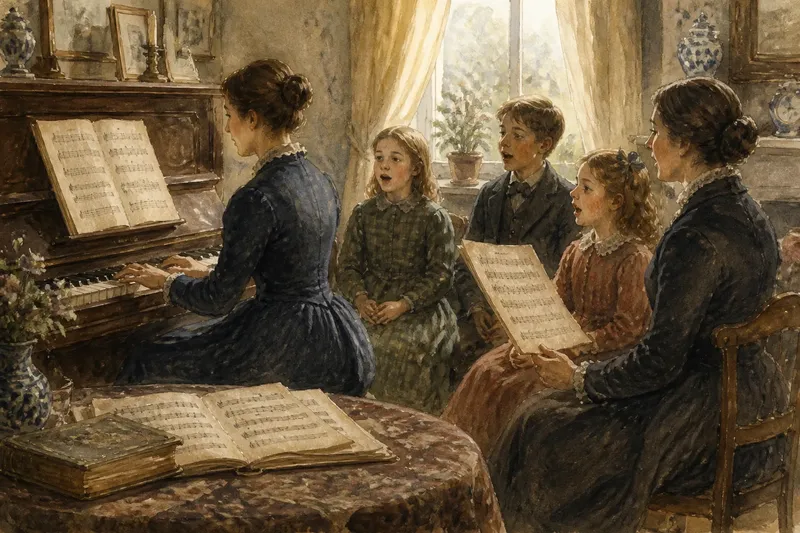
In a nineteenth-century British parlor, a piano, a printed song sheet, or a familiar refrain could turn an evening gathering into a music-making occasion. Household music in Britain varied with people’s means, interests, and available space; it was not a single routine shared by every family.
Focusing on this place and period makes the picture more useful. Voices could carry songs without instruments, while songbooks and pianos offered other ways to learn and accompany music. These are illustrative patterns, not claims that every British home owned an instrument or sang together.
Shared singing made songs available without instruments
A group could begin with one person who knew a song and join by listening, repeating its refrain, or following the melody. Printed words could help when a singer had a copy, but learning by ear also mattered. Small changes in wording or tune could emerge as people remembered and passed a song along.
Some songs belonged to particular occasions, including family gatherings and religious observances. Singing could give a group a shared activity, but the reason for a song depended on its setting and the people singing it. A parlor song, a hymn, and a work song did not serve the same purpose simply because people could sing all three.
Song sheets and pianos supported parlor music
Printed sheet music made particular songs available in a written form. A household with a piano and someone able to play could use a song sheet to support singing or instrumental performance. The presence of printed music does not tell us who joined in, how often a song was played, or whether a given household had a piano.
Access differed among households. Some could use a piano or printed music; others relied more heavily on memory and voices. A person who played could lead a tune, while others sang, listened, or kept a simple pulse. The instrument could invite participation, but it could also make one player the center of attention.
Rooms and routines shaped the kind of music people made
Space, household schedules, and nearby listeners affected what was practical. A crowded gathering could favor singing that needed little setup, while a quieter parlor might suit a small group around a piano. These are possibilities shaped by circumstance, not a universal map of how British homes were arranged.
A song is a little like a well-used recipe: its recognizable core can remain while each household adapts it to the people and tools at hand. One group might sing a melody from memory; another might follow printed music at a piano. The form changes, but both can keep the song in circulation.
Imagine a British household in the nineteenth century with a piano, one person who can play a simple song, and children who do not read music. The player starts the melody, sings the refrain, and pauses so the children can echo it. The result is concrete: the children can join the refrain without needing to read the score, while the player still carries the melody. If they lose the tune, the group can repeat the refrain or choose a simpler song.
How did household music work in nineteenth-century Britain?
How could people learn songs without recordings?
They could listen to someone sing or play, repeat phrases, and learn from relatives or other people who knew the song. Printed music also offered a written version where it was available, though it could not capture every variation in performance.
What did a piano add to household singing?
A piano could supply melody or accompaniment for singers who knew the song. It depended on access to an instrument and someone able and willing to play, so it was one option rather than a feature of every household.
Did every British household sing together?
No. Household interests, resources, customs, and daily demands differed. Music might involve a group, a solo performer, or no household performance at all.
What role did printed song sheets play?
They provided written words or music for particular songs and could support performance at home. A surviving sheet shows that a version was printed, not that every household owned or used it.
Household music moved through memory and changing versions
A visitor or relative could carry a tune from one gathering to another, teaching it by singing or recalling only its most memorable phrase. A song might change as people learned it by ear. Printed music preserves a written version, while performance and memory help explain how people could make that version their own.
To understand household music in nineteenth-century Britain, look at the ways songs could be shared: through voices, printed sheets, and instruments such as the piano where available. The useful distinction is not between a musical household and an unmusical one, but among the different means people had to make or pass on a song. That focus keeps the history specific without pretending that one pattern fits every home.