One Instrument, One Focused Listening Session
A one instrument listening session reveals entrances, changes, and musical exchanges through three focused passes, without turning a song into homework.
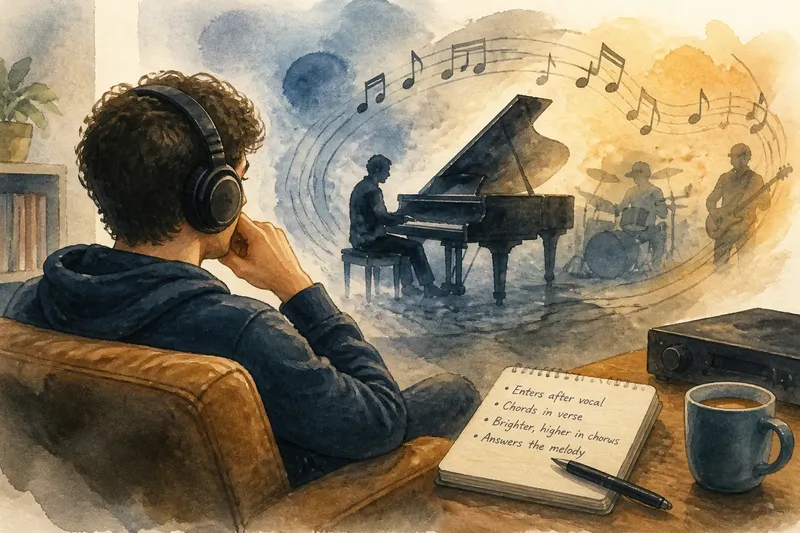
A one instrument listening session can make a familiar recording feel newly legible: follow the guitar, piano, or another part through three passes, and you can hear when it enters, how it changes, and what it does with the rest of the band. Choose one track and give it a quiet stretch of attention; the session can fit the song rather than the clock.
The goal is not to prove what an instrument is doing. It is to notice more clearly how its part moves through the arrangement. A focused listen may take only a few replays, or longer if a passage keeps slipping away.
Choose a listening approach that fits the track
There are three useful ways to center a session on one instrument. A whole-song pass suits a part that stays audible and has a clear journey. A section-by-section pass helps when the arrangement is dense or the instrument comes and goes. A comparison pass works when the same instrument changes character across contrasting sections, such as a restrained verse and a full chorus.
Choose whole-song listening if you want to follow the part’s overall shape without stopping. Choose section-by-section listening if entrances or handoffs are easy to miss. Choose comparison listening if the contrast between sections is the main thing you want to understand. These options can overlap, but picking one as your main approach gives the session a useful center.
- Whole song: Check whether the instrument remains easy to distinguish from its first appearance to its last; if it does, follow it without stopping, and if it gets buried, switch to section-by-section listening.
- Section by section: Check whether the part has gaps or is masked in the full mix; if so, replay clear sections separately, and if not, return to a whole-song pass.
- Compare sections: Check whether the same instrument has different jobs in contrasting passages; if it does, compare those passages, and if not, focus on its overall shape instead.
Imagine you choose a track with piano chords in the verse and brighter, busier piano in the chorus. First, you listen through once and note where the chorus begins; next, you replay the verse and chorus separately, listening for changes in rhythm, register, and note density. If the chorus piano sounds higher and more active, your resulting observation is that its role shifts with the section; if the difference remains unclear, you can describe both passages as chordal support without claiming a change.
Set up the room and select one audible part
Pick a song you know well enough to follow, but not so well that you automatically sing along through every detail. Use speakers or headphones that let you hear comfortably, and lower background noise: pause notifications, put aside other audio, and choose a time when you are unlikely to be interrupted. Keep the track at a comfortable level; louder playback is not a substitute for concentration.
Choose an instrument with a recognizable tone or role. A piano’s struck notes, a strummed acoustic guitar, a sustained keyboard line, or a repeating drum pattern may offer a clearer starting point than a part buried in a dense arrangement. If you cannot tell whether a sound belongs to a particular instrument, track the sound itself—its pitch, attack, or position in the mix—rather than forcing a confident label.
Have a scrap of paper or a notes app nearby, but do not write continuously. Jot a few cues such as “enters after vocal,” “shorter notes later,” or “answers the melody.” Those observations are more useful than a full transcript of the song. If the recording has a clear section break, note it so you can return to that spot without searching.
Use three passes to hear the part’s changing role
Keep each pass centered on a different question. The sequence moves from arrival, to development, to interaction. It is like following one person in a conversation: first notice when they appear, then how their manner shifts, then who they respond to.
- Pass one: notice entrances and exits. Listen to the whole track without pausing. Mark when the instrument first becomes audible, whether it drops out, and when it returns. Also notice if its entrance coincides with a vocal line, a drum fill, or a change in the arrangement.
- Pass two: follow changes within the part. Replay the track or your chosen sections and listen for shifts in pitch, rhythm, tone, loudness, or density. A guitar might move from clipped chords to longer ringing notes; a keyboard part might spread into a higher register. Record only the clearest changes, and leave uncertain details open.
- Pass three: listen for exchanges. Follow moments when the instrument seems to answer, support, or leave space for another part. Notice a guitar phrase after a vocal line, a piano figure alongside a bass movement, or a drum fill that leads into a new section. The exchange can be subtle; a pause or a change in intensity may matter as much as a flourish.
You do not need to isolate the instrument with editing software. Ordinary playback is enough for a focused session, and repeated listening can reveal relationships that disappear when attention is split. If the part remains hard to identify, switch to a simpler track rather than turning the session into a guessing contest.
Common questions about a one instrument listening session?
Which instrument should I choose first?
Start with a part you can already recognize, such as a steady piano figure or a clearly strummed guitar. A familiar sound makes it easier to spend attention on its entrances and interactions instead of repeatedly asking what you are hearing.
Should I listen with headphones or speakers?
Use whichever lets you hear comfortably and stay focused. Headphones can make a quiet part easier to follow, while speakers may feel more natural if you want to hear the recording as a room-filling arrangement.
What if I cannot separate the instrument from the mix?
Choose a thinner section of the song and listen for the instrument’s distinctive attack, sustain, or rhythmic shape. If it is still unclear, describe the sound without naming its source, or select a track with a more exposed part.
Is it better to pause between passes?
A short pause can help if your attention has drifted, but immediate replays can make section comparisons easier. Use the break that keeps you curious rather than treating the session as a test.
Choose a track whose arrangement rewards attention
Some recordings give a single instrument a visible arc: it may enter alone, gain company, then recede. Others keep the part steady while surrounding voices and instruments change. Neither is a better choice. The first makes entrances and development easy to notice; the second can reveal how an unchanging part anchors a shifting arrangement.
If you are deciding between two songs, pick the one with a target part you can hear in more than one context. A guitar that appears beneath both a quiet vocal and a fuller chorus gives you useful contrast. A short instrumental passage can also help, because the target part may be less crowded there. You are not looking for the most complicated performance; you are looking for a track that gives your attention somewhere to land.
Keep your notes modest. A few time cues and observations are enough to guide another listen, while elaborate notation can pull attention away from the sound. If a phrase catches your ear, hum its contour after playback or describe it in plain language. You can return later with a different instrument as the focus, but give this session room to settle before switching targets.
A one instrument listening session is most useful when it changes what you hear on the next ordinary play. Keep one concrete observation—an entrance, a changed pattern, or an exchange—in mind, then let the rest of the recording come back into view. The instrument was never alone; you simply gave its part the quiet space to become clear.